ACT Practice Questions for Reading Success
· based on the channel PrepSolution
Key takeaways
- Includes 2 passages and 10 questions per practice set
- Focuses on main idea, detail, inference, vocabulary, and point of view
- Detailed rationales explain correct and wrong answers
- Strategies help eliminate distractors and verify evidence
- Free resources available at PrepSolution’s ACT Complete Prep System
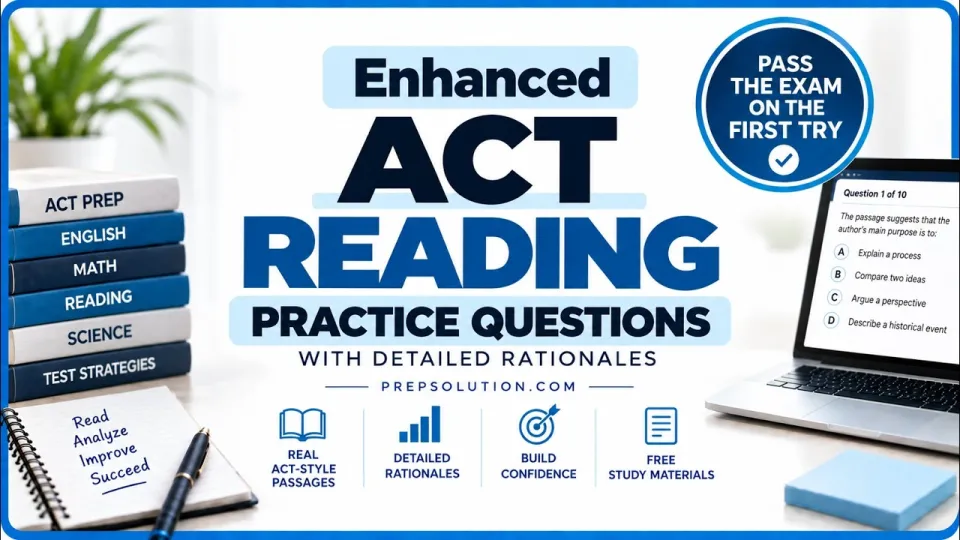
Video: ACT Reading Practice Questions | Detailed Rationales with Tips & Tricks
ACT practice questions are essential for improving your reading comprehension skills and achieving a high score on the ACT. These questions test your ability to understand main ideas, locate details, make inferences, interpret vocabulary in context, and analyze point of view. Using practice sets with detailed rationales and strategic tips allows you to learn not only what the correct answers are but also why other options are incorrect, helping you build confidence and accuracy.
Understanding the Types of ACT Reading Practice Questions
ACT reading practice typically involves passages from literary narratives and informational essays. Each passage is followed by questions targeting specific skills:
- Main Idea and Purpose — Identify the overall theme or goal of the passage without confusing it with minor details.
- Details and Sequence — Find exact lines or sentences to answer questions about facts or order of events.
- Inference and Evidence — Draw conclusions strictly supported by the text and link them to corresponding evidence.
- Words and Phrases in Context — Deduce meanings of unfamiliar words using surrounding sentences.
- Point of View — Determine who is narrating and how their perspective shapes the information.
Mastering these question types requires careful reading and practice with strategies that prioritize text-based evidence.
Strategies for Tackling ACT Reading Practice Questions
Effective ACT reading strategies involve multiple steps:
- Map the Passage: Quickly outline the structure and main points of the passage to keep track of ideas.
- Pause Before Answering: Resist the urge to answer immediately; instead, recall or locate exact evidence.
- Scan for Keywords: Use keywords from the question to find relevant lines in the passage.
- Eliminate Distractors: Remove answers that are partially true but do not fully answer the question or are unsupported.
- Confirm with Text Evidence: Match your chosen answer with a specific line or phrase in the passage to ensure accuracy.
Consistent use of these techniques reduces confusion, especially when two answers seem plausible.
How to Approach Main Idea and Purpose Questions
Main idea questions require understanding what the entire passage is doing. Avoid focusing on a single detail or example. Instead:
- Summarize the passage in your own words.
- Identify the author’s intent — to inform, entertain, persuade, or explain.
- Consider the genre and tone.
For example, a literary narrative passage might explore a character’s growth, while an informational essay could present a scientific concept. Recognizing this helps select the answer that reflects the passage’s overall purpose.
Handling Inference and Evidence Questions
Inference questions ask you to read between the lines but only to the extent the text supports. To answer these:
- Look for clues in the passage that imply something not directly stated.
- Avoid assumptions beyond what the text allows.
- Link the inference to a specific piece of evidence.
Practice sets with detailed rationales show why some tempting answers lack textual support, helping you refine your inference skills.
Decoding Words and Phrases in Context
Sometimes the ACT includes vocabulary questions for words unfamiliar to you. The best approach is:
- Cover or ignore the target word.
- Read the sentence and surrounding sentences to understand the context.
- Choose the answer that best fits the overall meaning.
This contextual strategy is more reliable than guessing based on partial knowledge.
Point of View and Narrator Role Questions
Questions about point of view require identifying the narrator’s role and perspective. To tackle these:
- Note pronouns and narrative style.
- Determine if the narrator is a character, an observer, or an omniscient voice.
- Assess how the narrator’s perspective influences the presentation of information.
This helps distinguish between subjective opinions and objective facts in the passage.
Useful Resources for ACT Reading Practice
For more practice questions, detailed explanations, and comprehensive ACT prep, visit PrepSolution’s ACT Complete Prep System. This resource offers structured practice with answer walkthroughs and strategies tailored for the 2026 ACT.
Итог
ACT practice questions focused on reading comprehension are crucial for mastering the test’s demands. They develop your ability to identify main ideas, analyze details, make supported inferences, interpret vocabulary, and understand point of view. By applying strategic approaches and learning from detailed rationales, you improve accuracy and confidence. The channel PrepSolution offers valuable guidance and resources to help you succeed with ACT reading sections. For more practice and expert tips, explore their complete prep system at the provided link.
Source: ACT Reading Practice Questions | Detailed Rationales with Tips & Tricks · Markdown version
Questions & answers
What types of passages appear in ACT reading practice questions?
ACT reading passages typically include literary narratives and informational essays, each designed to test different comprehension skills such as story understanding and factual analysis.
How can I effectively eliminate wrong answer choices on the ACT Reading section?
Use text evidence to confirm your answer and eliminate options that are only partially correct, unsupported by the passage, or misinterpret the question’s focus.
What is the best way to understand unfamiliar words on the ACT Reading test?
Cover the unfamiliar word and use the surrounding sentences to infer its meaning from context rather than guessing based on the word alone.
Why is it important to identify the narrator’s point of view in ACT Reading questions?
Knowing who is telling the story and their perspective helps you understand subjective biases, the tone, and how information is presented, which is essential for answering related questions accurately.